



What's the Difference?
If you've ever tried to pack a standard beach towel into a bag that's already holding sunscreen, a change of clothes, a book, and a water bottle, you know the problem. The towel takes over. It's thick, bulky, and somehow manages to expand to fill whatever space is available. By the time you add a second towel for someone else, you're basically carrying a duffel bag full of terry cloth.
Turkish towels solve this in a way that feels almost too simple: they're thin.
But here's where it gets confusing. If you've never used a Turkish towel before, "thin" sounds like a downgrade. We've been conditioned to associate thickness with quality, especially when it comes to towels. A plush, heavy towel feels luxurious. A thin one feels... cheap? Insufficient? Like it won't work as well?
Except it does. Often better.
So what's actually different between a Turkish towel and a standard beach towel, and when should you choose one over the other?
The Construction: Loops vs Flat Weave
The biggest difference between Turkish towels and traditional beach towels is how they're made.
Standard beach towels — the thick, fluffy kind most of us are familiar with — use a terry cloth construction. Terry cloth is woven with loops of thread that stick up from the base fabric, creating that soft, spongy texture. Those loops are what make the towel thick and what give it that plush feel when you wrap it around yourself.
Turkish towels, by contrast, use a flat-weave technique. There are no loops. The cotton is woven tightly in a smooth, even surface, more like a very finely woven blanket than a traditional towel. The weave is dense but not heavy, and the fabric has a slight texture without any raised pile.
This difference in construction changes everything about how the towel performs.
Weight and Portability
Let's start with the obvious: Turkish towels are significantly lighter than terry beach towels.
A standard beach towel can weigh anywhere from 1 to 2 pounds when dry. Add water to it and you're easily carrying 3-4 pounds. Two towels? You're hauling around 6-8 pounds of wet fabric.
A Turkish towel, by comparison, usually weighs between 8-12 ounces dry. Even when wet, it's noticeably lighter because the flat weave doesn't hold as much water in the fabric itself.
This matters most when you're traveling. Whether you're packing for a beach weekend, a trip to the pool, or a week by the ocean, Turkish towels take up a fraction of the space and add almost no weight to your bag. You can fit two or three Turkish towels in the space one thick beach towel would occupy.
If you've ever been annoyed by how much of your suitcase is consumed by towels, this alone might convert you.
The Sand Problem
Anyone who's spent time at the beach knows the frustration of trying to shake sand out of a terry towel. The loops trap sand — not just on the surface, but deep in the fabric. You shake it, you beat it against a railing, you hang it up and hope the wind does the work. And still, when you fold it up to go home, there's sand everywhere.
Turkish towels don't have this problem.
Because the weave is flat and tight, sand doesn't embed itself in the fabric. It sits on the surface. One good shake and it's gone. You can literally watch the sand slide off in a single motion.
This isn't a small thing. It's the difference between getting in the car with a relatively clean towel and getting in the car with a sandy mess that leaves grit all over your seats and floor mats.
Drying Time: The Biggest Practical Difference
This is where Turkish towels really separate themselves from standard beach towels.
A thick terry towel, when wet, stays wet for hours. Sometimes overnight. If you're at the beach all day and you use your towel multiple times — after a swim, after rinsing off, after another swim — the towel never fully dries. It just gets progressively damper and heavier.
By the end of the day, you're packing up a soggy, heavy towel that will sit in your bag until you get home. If you're on a multi-day beach trip, this becomes a real problem. Damp towels start to smell. They get musty. You either have to bring multiple towels or resign yourself to using a wet one the next day.
Turkish towels dry fast. Hang one over a chair or a railing after a swim and it's usually dry — actually dry, not just less wet — within an hour or two. Sometimes faster if there's sun and a breeze.
This means you can use the same towel multiple times in one day without it feeling damp. It means you can pack a dry towel at the end of the day instead of a wet one. And it means you don't need to bring as many towels on a trip because the ones you have will be ready to use again quickly.
If you've ever dealt with the damp-towel problem, this alone makes Turkish towels worth trying.
Absorbency: Thin Doesn't Mean Less Effective
The assumption most people have is that a thicker towel must absorb more water. More fabric equals more absorbency, right?
Not exactly.
Absorbency is about how well the fibers pull moisture away from your skin and how quickly they do it. A thick terry towel absorbs a lot of water, yes — but much of that water stays trapped in the loops of the fabric itself. That's why terry towels feel heavy when wet and take so long to dry.
A Turkish towel absorbs differently. The flat weave creates more surface area in direct contact with your skin, which means it pulls moisture away efficiently. And because the weave is breathable and the cotton is high-quality, the water doesn't just sit in the fabric — it evaporates.
In practice, this means a Turkish towel dries you off just as well as a thick beach towel. It doesn't feel as plush or enveloping, but it gets the job done. And because it dries faster, it's ready to do the job again much sooner.
Versatility: More Than Just a Towel
Standard beach towels are designed to do one thing: lay on the beach and dry you off after swimming. They're good at this, but they don't really do anything else.
Turkish towels, because they're lighter and more fabric-like, are significantly more versatile.
You can use a Turkish towel as:
This versatility comes from the fabric itself. It's woven more like a textile than a traditional towel, which makes it flexible and adaptable. It drapes well, folds compactly, and doesn't feel out of place used in ways a thick terry towel would.
If you're someone who values multi-use items and doesn't want to own ten different things that each do one job, Turkish towels make sense.
Size Options
Both Turkish towels and standard beach towels come in a range of sizes, but the proportions feel different.
A typical beach towel is around 30" x 60" — large enough to lie on but not dramatically oversized. Turkish towels often come in similar dimensions, though some traditional styles are longer and narrower (more like 40" x 70"), which makes them easier to wrap around yourself.
Because Turkish towels are thinner, even a larger size doesn't feel bulky. A 40" x 70" Turkish towel folds down to about the size of a thick sweater. A beach towel of the same dimensions would be significantly larger when folded.
Aesthetics and Style
This is subjective, but it's worth mentioning: Turkish towels look different.
Standard beach towels often come in bright colors, bold patterns, tropical prints. They're designed to look fun and beachy, which is great if that's the vibe you want.
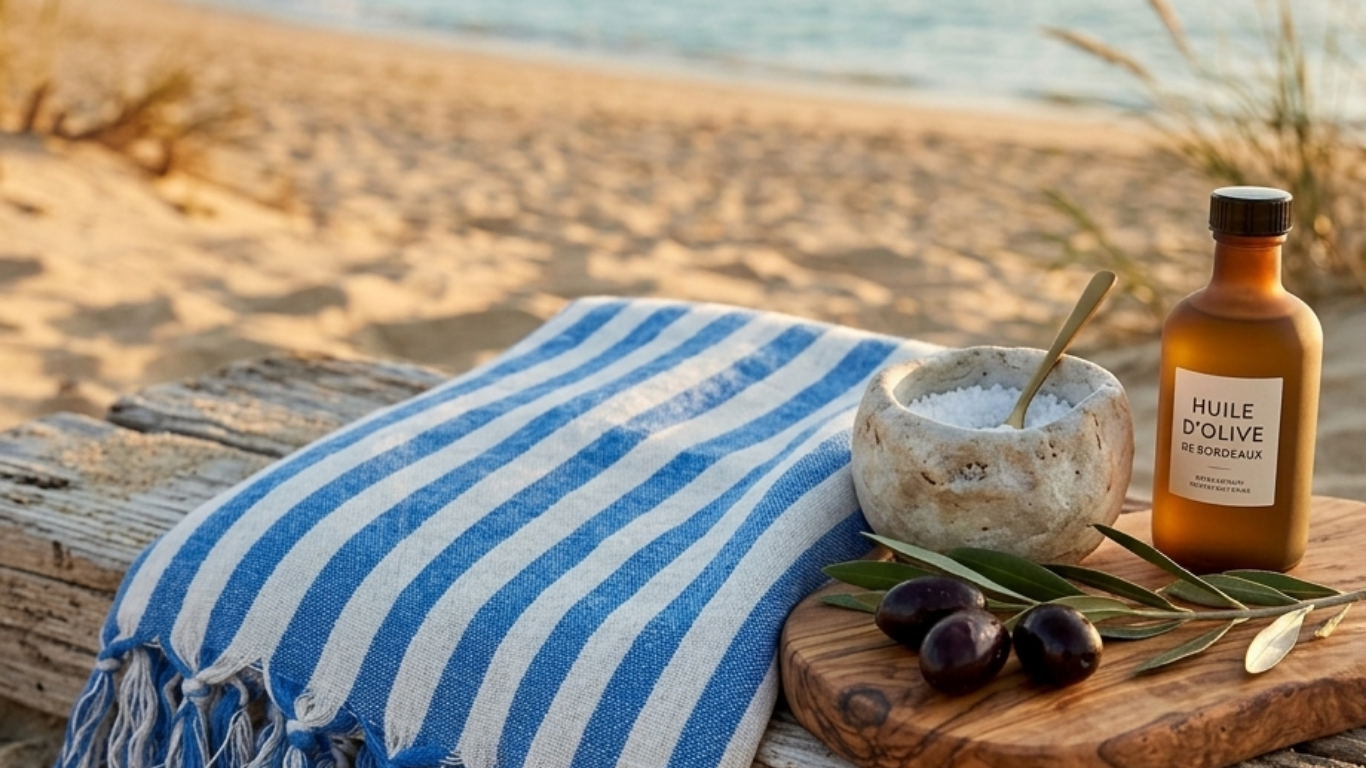
Turkish towels tend to have a more refined, understated aesthetic. Classic stripes, subtle colors, simple borders. They look equally at home on a beach in Greece and draped over a chair in your bathroom.
If you care about how things look — and a lot of people do — Turkish towels feel more versatile visually. They don't scream "beach toy." They're elegant enough to live in multiple contexts without feeling out of place.
Durability: What Lasts Longer?
This depends entirely on quality.
A cheap beach towel will pill, fade, and fall apart relatively quickly. But a well-made terry beach towel can last years.
Same with Turkish towels. A poorly made one won't hold up. But a good Turkish towel — woven from long-staple cotton with reinforced edges — will last as long or longer than a terry towel, and it'll get softer and more comfortable over time instead of rougher.
The advantage Turkish towels have is that because they're thinner, they go through less wear and tear in the wash. They dry faster, which means less time in the dryer (or no dryer time at all), and the flat weave is less prone to snagging or pulling than looped terry.
When to Choose a Beach Towel Instead
Turkish towels aren't perfect for every situation.
If you want the feeling of sinking into something thick and plush after a swim, a terry beach towel delivers that in a way a Turkish towel doesn't. There's a certain cozy, enveloping quality to a thick towel that some people really love, and Turkish towels don't replicate it.
Terry towels also tend to stay put on the sand better. Because they're heavier, they don't blow around as easily in the wind. If you're at a particularly breezy beach and you want to lay out a towel and leave it, a thick beach towel has an advantage.
And if you don't care about packing space or drying time — maybe you're just driving to a local beach for the afternoon and you'll toss everything in the wash when you get home — then the benefits of a Turkish towel matter less. A thick beach towel will do the job just fine.
So Which Should You Choose?
If you travel, if you care about packing light, if you're annoyed by damp towels and sand that won't shake out, or if you want something that works as a towel but also doubles as a blanket or wrap — choose a Turkish towel.
If you prefer thick, plush terry cloth and you don't mind the extra weight and bulk, stick with a traditional beach towel.
Both work. They just work differently.
We're obviously biased — we make Turkish towels because we think they're better for most people in most situations. They're lighter, faster-drying, more versatile, and they solve a lot of the small annoyances that come with traditional beach towels.
But "better" is subjective. What matters is what works for you.
Shop Turkish Towels — Lightweight, quick-drying, made for the beach and beyond.
